

Last updated: October 2026
Key takeaway:A corporate photographer creates purposeful business images such as headshots, executive portraits, workplace stories, and event coverage for use across websites, LinkedIn, proposals, recruiting, and PR. The best results come from a clear brief, a practical shot list, consistent lighting, and written usage terms - not from simply taking more photographs.
By Sumeet S., Founder & CEO - Silver Valley Studios Inc.
Last updated: October 29, 2026
What does a corporate photographer do?
A corporate photographer plans and produces images for an organization’s communication and marketing needs. The work may include consistent employee headshots, leadership portraits, workplace and customer scenes, commercial-space imagery, conference coverage, or a library of photographs for ongoing campaigns.
Unlike a personal portrait session, corporate photography begins with business use cases. A marketing team may need images for a new website, a recruiter may need approachable team photographs, and an executive may need a portrait for a speaker biography. One well-planned production can address several of those needs if the brief, locations, people, and deliverables are agreed in advance.
Silver Valley Studios Inc. is based in Maple Ridge, BC, and produces photography and video for brands, businesses, events, and commercial spaces across the region. The studio works with organizations that need clean, consistent visual content rather than a one-off image with no plan for where it will be used.
Why invest in corporate photography?
Professional business imagery helps an organization present the same level of care across its website, sales materials, social channels, recruiting pages, and media communications. Consistent photographs also reduce the time designers and marketers spend trying to make unrelated images look as though they belong together.
The value is practical: the right images make it easier to explain who you are, what your team does, and what a customer can expect. They can also give employees and leaders a consistent public presence without relying on casual phone photographs taken at different times and under different lighting.
Common business uses
- Team pages and LinkedIn: Matching headshots create a cohesive employee directory and make new team members easier to add later.
- Leadership communications: Environmental portraits provide context for biographies, speaking engagements, announcements, and media requests.
- Recruiting: Authentic workplace photographs show how people collaborate and help candidates understand the environment they may join.
- Sales and proposals: Purposeful images can illustrate a process, facility, service, or customer experience more clearly than generic stock photography.
- Events and public relations: Photographs document key moments while giving the organization useful material for recaps and future promotion.
- Social content: A planned mix of horizontal, square, and vertical crops gives a team more options after the shoot.
A useful corporate session is therefore an asset-building exercise. Before booking, identify the pages, campaigns, or communications the photographs must support. That list will determine who should be photographed, which locations matter, and whether still images alone are enough.
Which type of corporate photography do you need?
Most business projects combine more than one format, but each type solves a different communication problem. Start with the decision the image must support, then choose the format that gives viewers enough context.
Team headshots
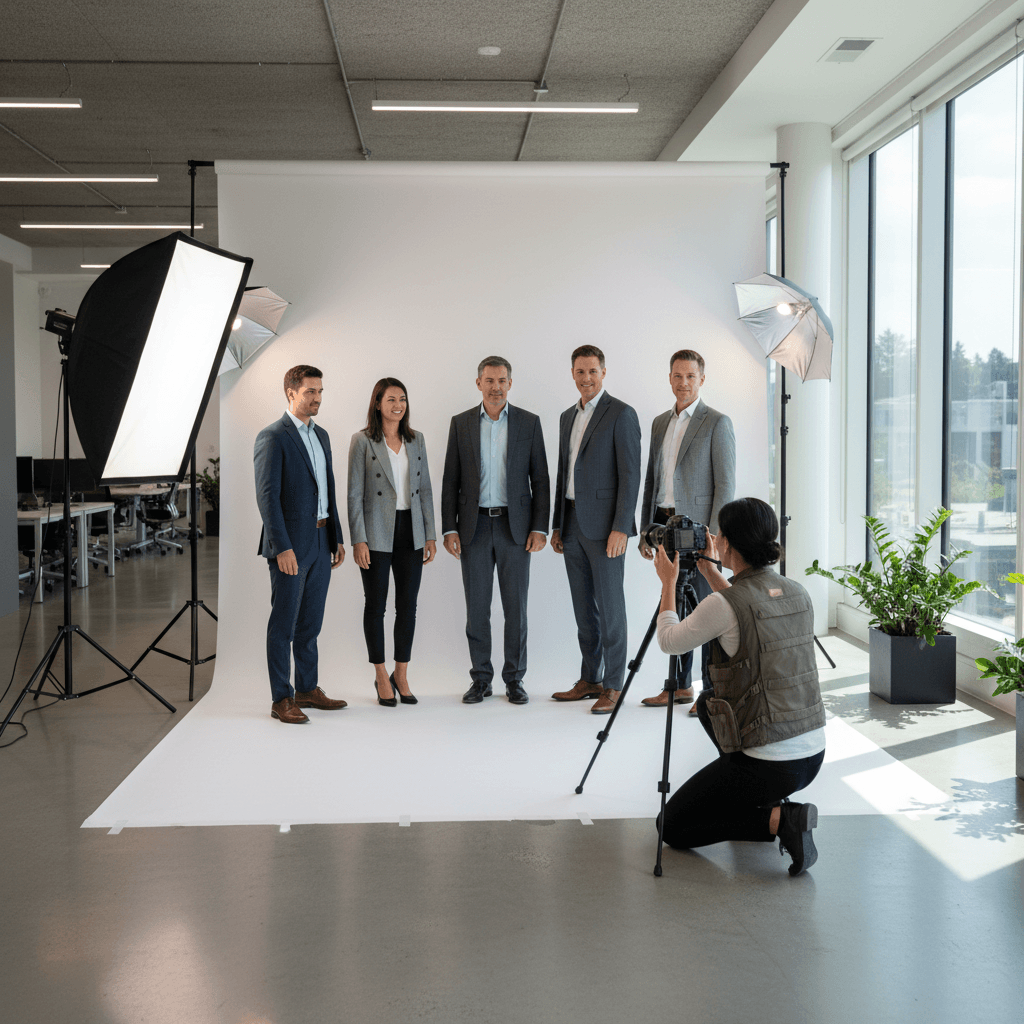
Headshots are the right choice when the main requirement is a consistent visual identity for employees, directors, advisors, or service professionals. A repeatable background, lighting setup, crop, and expression direction make the images work together on a team page, email signature, directory, or LinkedIn profile.
Headshot days work best when people arrive in scheduled groups rather than all at once. A simple background and controlled lighting can make the experience efficient, while a short conversation and clear prompts help each person look natural.
Executive and environmental portraits
Environmental portraits place a leader or specialist in a relevant setting such as an office, studio, workshop, restaurant, or commercial space. They are useful when context matters - for example, when a portrait needs to communicate leadership, technical expertise, hospitality, or the scale of a facility.
These portraits need more time than a uniform headshot because the photographer must assess the background, light, composition, and activity around the subject. They are often valuable for press kits, annual reports, speaking profiles, thought-leadership articles, and website introductions.
Brand library and workplace imagery
A brand library is a collection of planned scenes that can be reused across marketing channels. It may include collaboration, customer service, product use, hands at work, meetings, entrances, details, and wide views of the space.
The strongest libraries avoid staged scenes that could belong to any company. A shot list should identify real services, workspaces, tools, and interactions that make the organization recognisable. Include both people-focused photographs and detail images so designers can build layouts without repeating the same composition.
Corporate and event coverage
Event coverage follows a schedule rather than a fixed set of poses. The photographer should understand the run of show, priority speakers, awards, sponsors, networking periods, and any restrictions on access or flash. A short briefing prevents the team from missing the moments that matter most.
For conferences, launches, dinners, and community events, plan a mixture of keynote photographs, audience reactions, details, wide room views, sponsor visibility, and candid conversations. Those categories create a more useful recap than a gallery made entirely of people standing beside a branded wall.
How to plan a corporate photography session
A corporate shoot becomes more efficient when decisions are made before the photographer arrives. The planning process does not need to be complicated, but it should produce a written brief that the client, photographer, and people on site can follow.
1. Define the communication goals
Write down where the photographs will appear and what they need to communicate. Separate immediate needs, such as a website launch or staff directory, from reusable content that can support future sales, recruiting, or social campaigns.
Also identify the required orientation and approximate crop. A website hero image may need room for text, while a LinkedIn headshot may need a closer vertical crop. Knowing this before capture helps the photographer leave appropriate negative space and create useful variations.
2. Build a must-have shot list
Divide the list into essential, useful, and optional scenes. For a small business, 20 to 40 purposeful shots may cover the most important needs; a larger organization or event may require a more detailed production plan.
- List the people who must be photographed and their available times.
- Identify locations, rooms, products, tools, and brand details that should appear.
- Mark photographs that require horizontal, vertical, or square flexibility.
- Reserve time for unscripted moments rather than filling every minute with poses.
- Note privacy, access, safety, or confidentiality restrictions before the day.
3. Prepare people and locations
Send wardrobe and grooming guidance several days ahead. Solid colours, well-fitting clothing, clean glasses, and simple accessories are usually easier to photograph than tight patterns or distracting logos. If a brand has specific colours or styling rules, include them in the brief rather than leaving the decision to each employee.
Walk through the location before the session when possible. Check available depth, window direction, background distractions, noise, access to power, and whether employees can continue working nearby. A conference room may work well for headshots, while a real workplace may be better for environmental scenes.
4. Schedule realistic blocks
Simple headshots can be scheduled in short, staggered appointments, while environmental portraits need more space for movement and lighting changes. Keep a buffer for late arrivals, wardrobe adjustments, executive meetings, and equipment changes. For offices across Maple Ridge, Langley, Surrey, or other Lower Mainland locations, travel time should be included rather than treated as an afterthought.
Maple Ridge sessions may also need a weather or daylight plan when natural light is important. A controlled lighting setup provides a dependable alternative during darker winter days or when an outdoor location becomes impractical.
What happens on the day and after the shoot?
A professional workflow should feel organised without making people feel rushed. The photographer confirms the schedule, checks the location, tests lighting, and explains what each participant should do before the first final frame is made.
Briefing and setup
The photographer reviews the shot list, identifies the priority images, and establishes the main lighting approach. For headshots, a controlled background and repeatable light make the group consistent. For brand scenes, the team may use available space, practical light, and additional fixtures to keep the setting believable while maintaining quality.
Capture and review
Tethered capture can show selected frames on a larger monitor while the session is underway. This is useful when a marketing or leadership stakeholder needs to confirm expression, composition, wardrobe, or background before the team changes setups. It is not a substitute for creative direction, but it can prevent avoidable surprises.
Editing and delivery
Agree on the editing style before the shoot. Corporate retouching should generally preserve recognisable features while addressing temporary distractions, uneven exposure, or background issues. Ask how files will be named, organised, cropped, and delivered so the final library can be used without another sorting project.
Useful deliverables may include high-resolution files for print, web-ready versions, social crops, and a folder structure based on people, scenes, or campaigns. Confirm whether colour and black-and-white versions are required rather than assuming every image should be delivered in both treatments.
How do you choose a corporate photographer?
Review a photographer’s work against your actual brief, not just a collection of favourite images. A dramatic portrait may demonstrate technical skill but say little about whether the photographer can manage 30 employees, work around an operating business, or cover an event discreetly.
Questions to ask
- Can I see complete galleries? Look for consistency across a full headshot set or event gallery, not only selected highlights. You can review the corporate photography portfolio for examples of varied business imagery.
- How do you organise the day? The photographer should be able to explain the brief, shot list, arrival schedule, setup, backup plan, and delivery stages.
- Can you work in our location? Ask how the team handles limited space, active offices, difficult weather, low light, or multiple locations.
- What will we receive? Confirm file types, crops, editing, turnaround, naming conventions, and whether video is included or separately planned.
- What usage is included? The agreement should describe where and how the organisation may use the images, and whether any broader licence or assignment is available.
- How are sensitive images handled? Discuss employee consent, customer privacy, confidential material, and whether the photographer may display the work publicly.
Warning signs include an unclear delivery process, no written agreement, vague usage language, an inability to show relevant full galleries, or a promise that every project will be completed without discussing the people and locations involved. A reliable photographer asks detailed questions before quoting because the scope affects time, crew, equipment, and post-production.
What should the contract cover?
Image delivery and image ownership are not automatically the same thing. In Canada, copyright generally exists in an original work when it is fixed, and the creator may retain rights unless the agreement says otherwise. The Canadian Intellectual Property Office explains the basics of copyright protection and why it matters for business materials.
For a corporate project, the written agreement should identify the deliverables, payment terms, permitted uses, territory, duration if relevant, exclusivity if relevant, and whether the client receives a licence or an assignment. It should also address postponement, cancellation, reshoots, archival storage, and permission to use photographs in the photographer’s portfolio.
Consent deserves separate attention when recognisable employees, customers, children, visitors, or members of the public appear. Decide who will obtain releases, how the images may be used, and what happens if somebody withdraws from a planned campaign. For legal interpretation or a complex commercial arrangement, obtain advice from qualified Canadian counsel rather than treating a general article as a substitute for a contract review.
Keep a record of the final agreement and any restrictions attached to individual photographs. That makes future reuse easier and reduces the risk of a team member downloading an image for a purpose that was never authorised.
Should you combine photography and video?
Combining photography and video can be efficient when both are planned as one production rather than added at the last minute. The same location, people, styling, and brand direction may support short leadership messages, workplace clips, event teasers, or vertical social content.
There are trade-offs. Video requires sound, movement, timing, and often a quieter environment, while still photography can work around normal office activity. Decide which deliverable has priority and build the schedule around that priority. A short shot list for vertical clips is more useful than a vague request for “some video.”
Silver Valley Studios Inc. provides photography, video, and commercial visual services for organisations that want the still and moving-image work coordinated. The scope should still state exactly what is being captured and delivered.
Corporate photography checklist
Use this checklist before approving a shoot date:
- Define the audiences and channels the images must support.
- Separate essential shots from optional ideas.
- Confirm the people, locations, products, and activities that must appear.
- Prepare wardrobe, grooming, privacy, and access guidance.
- Build a schedule with arrival times and realistic buffers.
- Agree on lighting style, backgrounds, composition, and retouching expectations.
- Confirm image formats, crops, filenames, folders, and delivery timing.
- Review licensing, consent, portfolio permissions, cancellation, and reshoot terms.
- Assign one person to make decisions on the day.
- Plan how the final library will be stored and reused.
This preparation is especially helpful for a growing company. A consistent process makes the next employee headshot, campaign refresh, or event easier to add without rebuilding the visual system from scratch.
What does a professional workflow look like?
Reliable equipment supports a reliable process, but equipment alone does not make a corporate image effective. A photographer may use mirrorless cameras, prime lenses, soft modifiers, tethered capture, calibrated displays, colour references, and redundant data storage to control quality from capture through delivery.
The important outcome is repeatability. Lighting should remain consistent across a team, files should be backed up, and the client should know which images are final. A clear folder structure and useful filenames can save a marketing coordinator substantial time when a photograph is needed months later.

For a team session, the visible setup may be compact: a background, a few lights, a tethering station, and an organised queue. For a brand or event production, the workflow expands to include location changes, schedule coordination, ambient conditions, and a larger data-management plan.
Examples for Maple Ridge and Greater Vancouver businesses
A Maple Ridge professional-services firm might need uniform headshots, leadership portraits, and workplace scenes for a refreshed website. A restaurant may need staff interaction, food and space details, and event photographs that show atmosphere without interrupting service. A property developer or commercial operator may require people-focused brand content alongside photographs of the space itself.
In each case, the best brief is specific to the business. It should show the people, places, services, and customer experience that make the organisation different - not recreate a generic corporate image library.

For event coverage, share the schedule and priority moments before doors open. For office photography, identify working areas where confidentiality and safety matter. For multi-location work across the Lower Mainland, group nearby scenes together and allow time for travel and setup rather than treating each location as an isolated appointment.
Corporate photographer FAQ
How far in advance should we book a corporate photographer?
Book as soon as the date, people, and location are known. Small headshot sessions may be easier to schedule than multi-location productions or major events, which require more coordination. Earlier planning also leaves time to approve the shot list, communicate wardrobe guidance, and resolve consent or access questions.
What should employees wear for corporate headshots?
Choose clean, well-fitting clothing that suits the organisation and does not create distracting patterns or reflections. Solid colours are often straightforward, but the final guidance should reflect the brand and the background selected. Ask employees to bring an alternative layer when a second look would be useful.
Can a photographer capture headshots, workplace photos, and video in one day?
It can be possible when the schedule, crew, locations, and priorities are planned together. Headshots need a repeatable setup, while workplace scenes and video need movement and sometimes quiet recording conditions. The brief should identify which deliverable takes priority and how many final photographs or clips are expected.
Who owns the photographs after a corporate shoot?
Ownership and usage depend on the written agreement and the applicable law. Do not assume that paying for photography automatically transfers every copyright interest or grants unlimited reuse. Ask for clear terms covering the channels, duration, territory, editing, sublicensing, portfolio use, and any assignment or licence included.
Plan your corporate photography session
A corporate photographer can give your organisation more than a set of attractive images: the right process creates a usable visual library for people, places, services, events, and campaigns. Start with your communication goals, build a realistic shot list, confirm usage terms, and choose a photographer whose complete workflow matches the scale of your project.
When you are ready to discuss a Maple Ridge or regional British Columbia production, contact Silver Valley Studios Inc. with your goals, preferred date, locations, and must-have deliverables.