

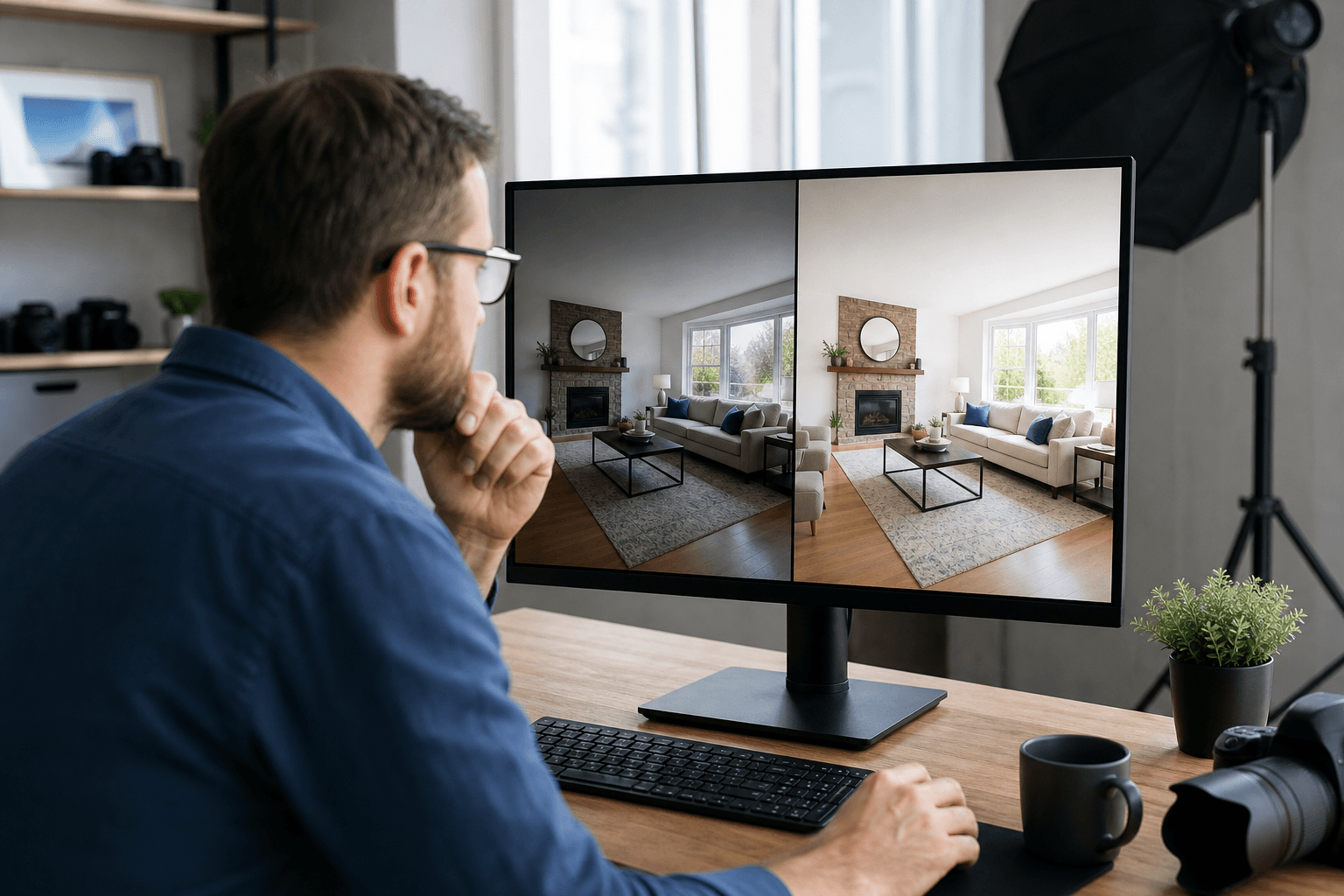
Image retouching services improve real estate photos through corrections such as exposure balancing, colour adjustment, perspective correction, and carefully scoped distraction removal. The strongest result begins with a clear brief: identify the problem, provide suitable source files, define what must remain accurate, and agree on the review and delivery process. If the source image cannot show the property truthfully, a new photo is usually the better solution. Related reading: Image retouching for realtors compared.
What image retouching services should solve
For real estate photography, retouching means refining an existing image so the property is easier to understand and more polished to view. It can address uneven light, distracting marks, minor clutter, colour inconsistencies, reflections, or perspective issues without changing the property's meaningful features.
The best brief starts with the visible problem, not an editing term. Tell the provider what the image needs to communicate, where it will be published, and which details must remain exactly as captured.
Describe the problem before choosing the treatment
A provider needs to know whether you are requesting a simple correction, targeted cleanup, compositing, or a simulated change. That distinction affects source-file requirements, review time, pricing, and the level of accuracy checking needed.
Presentation problems in an otherwise usable frame
Use standard correction when a room is fundamentally well captured but looks too dark, too bright, too cool, or inconsistent with the rest of the listing. Exposure balancing, white-balance correction, colour consistency, contrast control, sharpness adjustments, and perspective correction are typical examples.
A bright window beside a darker interior may need carefully blended exposures instead of simply increasing brightness across the whole frame. The goal is to retain window detail while keeping walls, floors, and furnishings believable.
Temporary distractions and visible marks
Minor distraction removal can suit a stray cable, small mark, rubbish bin, or isolated temporary object. Identify the exact item in the brief and provide a reference image or contact sheet so the editor can scope the work accurately.
Removal becomes higher risk when the item conveys useful information. Do not erase a fixed support, utility feature, access point, railing, retaining wall, or material defect that a buyer would reasonably expect to see.
Reflections, windows, and exterior conditions
Reflection control is useful when glare hides an interior feature or makes a window distracting. It may involve balancing exposures, reducing a reflection, or using another frame that captured the area more clearly.
Glass can reveal the actual surroundings, view, neighbouring buildings, or condition of the window. If the requested change would replace that context instead of improving visibility, identify it as a composite and request explicit approval before publication.
A sky adjustment can improve an exterior image when the original weather makes the property look flat, provided the result remains a fair representation of the setting and lighting. A plain correction is different from inserting a dramatic sky that changes the apparent time, weather, or atmosphere.
Vacant rooms and proposed changes
Virtual staging can help a viewer understand how an empty room might function, but it is not the same as photographing a furnished property. Any digitally added furniture should be treated as simulated and reviewed for believable scale, placement, and room flow.
Rendering or simulation serves a different purpose. It can communicate a proposed finish, renovation, or development concept, but it should not be presented as a photograph of the current property.
Physical staging is usually preferable when the furnishing itself is part of the property's actual presentation. Virtual staging may be more practical for selected rooms, a short launch window, or a property where temporary furniture is not available. The listing should distinguish a simulated image from an unaltered view.
When retouching cannot replace a new photograph
Retouching cannot reliably fix every weak source image. Book new photography when the composition misses a key feature, the perspective is misleading, the image is severely blurred or noisy, a room is blocked by an object, or the property has changed since the original capture.
A new photo is also the better choice when the current image has the wrong camera height, an awkward viewing direction, clipped architectural details, or insufficient room coverage. Editing can refine information that exists in the frame, but it cannot create a credible view of a feature that was never captured.
Use the same test for an old listing image: would a buyer understand the room, its proportions, its access, and its permanent features from the final result? If not, spend the budget on a more useful capture instead of adding increasingly complex edits.
Protect the truth of the listing
Accurate listing imagery should preserve room proportions, permanent fixtures, materials, meaningful views, access points, and site context. Improve the way the property is presented, but do not make a room appear larger, remove a permanent feature, alter a finish, or replace a view in a way that changes the buyer's reasonable understanding.
Before approving an edit, compare it with the original and ask four questions:
- Are the room dimensions and furniture scale still believable?
- Are permanent architectural and safety-related features still visible?
- Do materials, finishes, views, and outdoor conditions remain fairly represented?
- Would a buyer recognize the property when visiting in person?
Simulated furniture, proposed renovations, altered skies, and modified views deserve separate review because they communicate possibilities instead of an unchanged property. If the final image could reasonably be misunderstood, clarify its treatment before publishing it.
What affects the quote for image retouching services
Image retouching is usually scoped by the number of files, source quality, edit complexity, batch consistency, deadline, revision needs, publishing channels, and usage rights. A provider can quote more accurately when you identify the actual problem in each image instead of requesting a vague “full retouch.”
Correcting colour across 25 consistent interior photos is a different task from removing several objects, rebuilding reflections, or creating a simulated furnished room in five images. The number of images matters, but masking, compositing, reconstruction, and review often matter more.
Before commissioning extensive work, review how real estate photography fees can reflect post-production scope, deliverables, turnaround, and usage rights. The same planning logic helps you compare an editing-only quote with a coordinated photography package.
Include these details in a quote request
- The image count and file names or contact-sheet references.
- The exact problem in each image.
- The original files, alternate frames, and relevant property notes.
- The intended channels, such as MLS, a website, print, social media, or paid advertising.
- The required launch date and whether some images are urgent.
- What must remain unchanged, including views, fixtures, finishes, and room proportions.
- Whether the work is for listing marketing only or broader brand and advertising use.
- How proofs, focused revisions, approvals, and final exports will be handled.
A practical retouching brief and approval workflow

A clear workflow reduces avoidable revisions. Start by identifying the image and marketing problem, then provide the original file, intended channel, deadline, and accuracy boundaries before editing begins.
- Define the request. Separate standard corrections from object removal, composites, simulations, or day-to-night treatment.
- Send the source material. Provide the highest-quality original files and alternate frames that may help with windows, reflections, or difficult lighting.
- Confirm the scope. Agree on image count, deliverables, channels, usage, review method, and source suitability.
- Review a proof. Check colour, proportions, permanent features, views, reflections, and simulated elements.
- Request focused corrections. Group notes by file and describe the visible issue.
- Approve the finals. Confirm that the selected versions are accurate and suitable for publication.
- Organize delivery. Keep an approved master, channel-specific copies, and a clear naming or folder system.
Retouching timing should be agreed according to edit complexity and batch size. Silver Valley Studios publishes broader media timings of same-day HDR photos, 24-hour 2D floorplans, and 48-hour videos, but those timings are not promises for standalone retouching work.
Prepare files for publishing
Ask for the file types, dimensions, crops, and versions required for each intended channel before work starts. A useful handoff may include a high-quality master, web-ready copies, social crops, and one clearly identified version for approval, depending on the agreed scope.
Use consistent file names that connect each image to the property and room or view. Keep approved files separate from drafts, composites, and superseded versions so an earlier proof is not uploaded accidentally.
Do not assume that one export works equally well for MLS, a website, print, and social media. Give the editor the actual destinations and request channel-appropriate crops or dimensions without relying on unverified platform specifications.
Choose a listing-media workflow that fits the property
Coordinated capture is often more efficient than repairing an old image, especially when a listing needs photos, video, aerial context, and measurements at the same time. One prepared appointment can reduce repeated staging, access arrangements, and inconsistencies between deliverables.
Silver Valley Studios states that photos, vertical and cinematic videos, aerials, and floorplans can be captured in one booking, then delivered edited and pre-formatted for MLS, social media, and print. The appropriate mix still depends on the property: a standard home may need strong stills and a floorplan, while acreage, views, or outbuildings may benefit more from aerial context.
Choose retouching when the source frame already answers the buyer's question and only needs careful refinement. Choose a new coordinated shoot when the listing needs better coverage, a more credible perspective, current property conditions, or several formats built from the same visual plan.
Questions to ask before commissioning the work
- Can you identify which images are suitable for editing and which should be reshot?
- What is included in standard correction, and what counts as advanced compositing?
- How will permanent features, views, materials, and room proportions be protected?
- Will I review a proof before final delivery?
- How are revisions, urgent batches, and different edit levels handled?
- Which file versions and crops will I receive?
- Are the usage rights suitable for listing marketing, print, social media, or advertising?
- How will simulated or materially altered images be identified before publication?
Frequently asked questions
Can image retouching fix a poorly composed real estate photo?
Image retouching can refine a usable composition, but it cannot reliably replace a missing viewpoint, correct a severely misleading perspective, or recreate details that were never captured. A new photograph is usually more credible when the frame does not explain the room, feature, or property setting clearly.
Should I retouch an existing listing image or book a new photo shoot?
Retouch an existing image when the source is current, sharp, well composed, and already shows the property accurately. Book new photography when the image has poor coverage, incorrect perspective, severe technical problems, blocked features, or conditions that no longer match the listing.
What should I send when requesting an image retouching quote?
Send the original files, image count, exact edit requested for each file, intended publishing channels, deadline, property notes, accuracy boundaries, and any alternate frames. This information lets the provider separate simple corrections from masking, compositing, simulation, or work better handled through new photography.
Choose a listing-media workflow that fits the property
Image retouching works best when it solves a defined presentation problem without weakening the truth of the listing. If your property needs current capture and coordinated editing across photos, video, aerials, or floorplans, Silver Valley Studios Inc. provides real estate photography services for listing presentation in Maple Ridge and surrounding BC markets.