

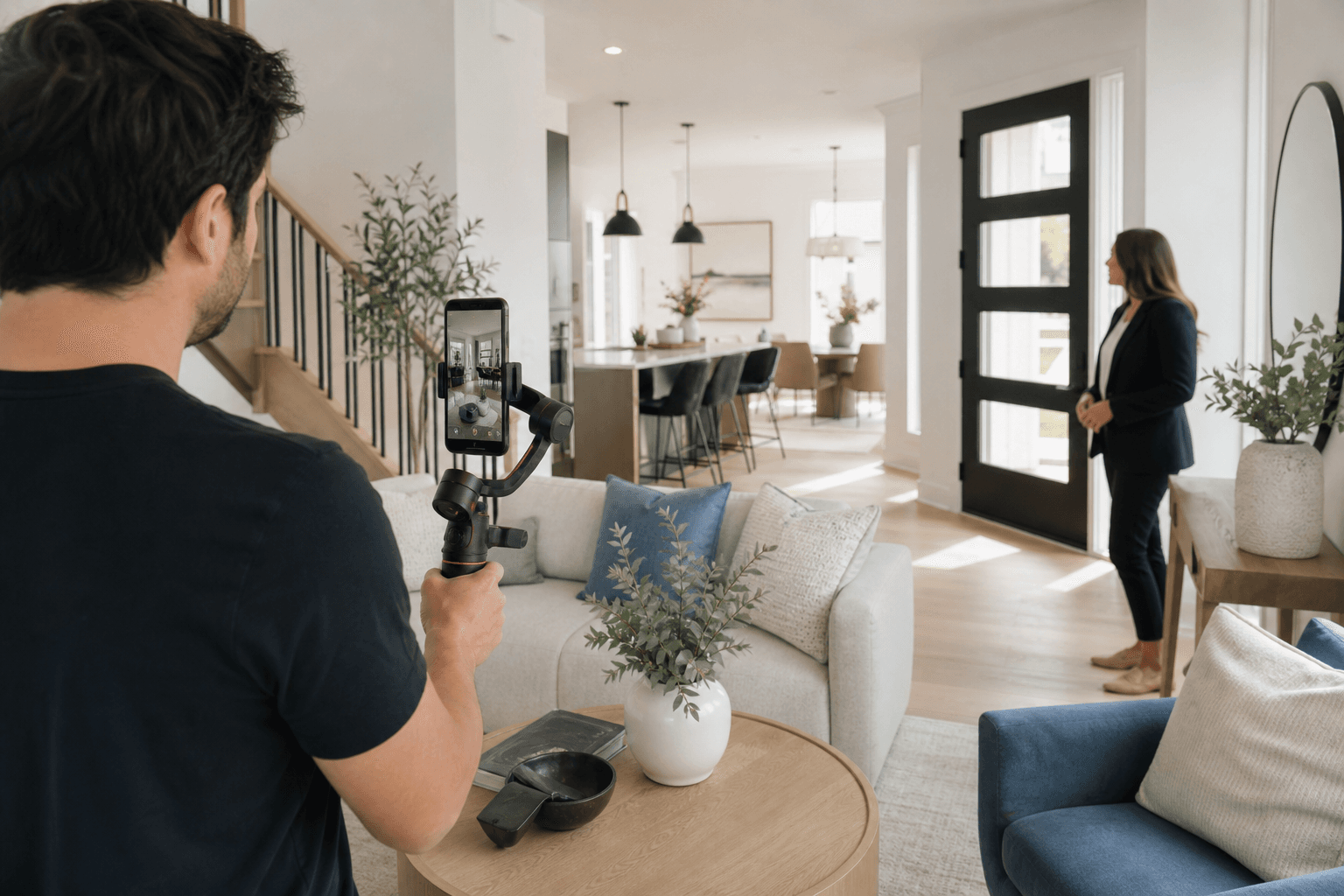
Property listing reels work best when each short vertical video answers one buyer question, such as what makes the home distinctive, how the rooms connect, or what the setting offers. Request 9:16 social-first edits with a clear opening, focused feature sequence, readable captions, and a factual call to action, then coordinate them with photos, floorplans, and any longer tour. Source: CREA Café | Reels for REALTORS® – Lessons Learned from CREA’s Social….
What property listing reels are meant to do
A property listing reel is a short, vertical social video designed to earn attention and explain one useful aspect of a home. It can introduce a standout feature, show the flow between rooms, present the lifestyle around a property, or give viewers a reason to continue to the full listing. Source: CREA Café | How Video Can Help REALTORS® Get Noticed.
Instagram Reels and TikTok videos are established formats that Canadian REALTORS® use to share information, expand reach, and connect with audiences. They are useful parts of a listing launch, but they do not replace accurate listing photos, a floorplan, or a longer property tour. CREA identifies listing videos and social-media videos as tools REALTORS® can use in their marketing, without treating any single format as a guaranteed source of leads. Related reading: 5 reels realtors.
Think of the reel as the entry point. Its job is to make the property understandable and interesting quickly enough that the viewer watches, saves, shares, visits your profile, asks a question, or moves to the complete listing.
Choose the reel format from the buyer question

The strongest reel concept depends on what a buyer needs to understand first. Before requesting “a few reels,” identify the property feature or uncertainty that the video should resolve.
| Reel format | Use it when the buyer needs to understand | Useful footage |
|---|---|---|
| Feature-led | Why this property is distinctive | The kitchen, view, renovation, ceiling height, backyard, workshop, or another defining feature |
| Room-to-room | How the layout connects | A clear path from entry to living areas, kitchen, bedrooms, or outdoor space |
| Agent-led | What the agent wants to explain personally | A brief introduction, guided feature, or answer to one common buyer question |
| Lifestyle | What living in the property might feel like | Outdoor entertaining, natural light, a covered patio, home office use, or neighbourhood context |
| Aerial opener | What the lot, view, access, or setting looks like | An elevated approach, pull-back, view corridor, lot context, or relationship to surrounding features |
| Floorplan-led | How a complex or unusual layout works | A simple floorplan graphic supported by room footage and clear labels |
Match the idea to the property
Choose a feature-led reel for a condo with a remarkable kitchen, a room-to-room sequence for a family home where flow matters, and a floorplan-led explanation for a split-level or multi-generational layout. If the setting is the main reason to consider the property, an aerial opener or lifestyle sequence may communicate more in the first few seconds than an interior montage.
Agent-led clips work well when the agent has a specific point to make, such as explaining a flexible den, a separate entrance, or the relationship between the kitchen and yard. Keep the message focused. An agent introduction followed by six unrelated features is harder to follow than one clear explanation supported by matching footage.
These formats also answer the common question, “What are some good Instagram posts for realtors?” A useful property post does not need to follow a generic trend. It can be a concise answer to a real buyer question, presented with footage that proves the point.
If you are choosing a reel maker or production provider, look for someone who can plan the concept, capture vertical footage deliberately, and coordinate it with the rest of the listing media. A provider that only crops a horizontal tour after filming may not give you the strongest framing for a vertical feed.
Build a reel that viewers can understand without sound
A good real estate video listing makes its subject clear immediately, shows one coherent idea, and remains understandable when the viewer has sound turned off. Start with a specific visual hook, follow it with supporting shots, add readable captions, and end with an accurate next step.
A practical five-part structure
- Opening frame: Show the feature or view promised by the caption. Avoid beginning with a slow logo animation or an exterior that gives no reason to continue.
- One clear promise: Use a short caption such as “A bright main floor built for entertaining” or “See how this split-level layout separates work and rest.” Keep the wording factual.
- Supporting sequence: Follow the opening with two to five related shots. A kitchen claim should lead to kitchen details, adjacent dining space, and the transition into the living area.
- Readable context: Add captions for room names, dimensions when verified, key features, or the question the reel answers. Place text away from platform interface areas and keep each caption on screen long enough to read.
- Factual next step: Direct viewers to the complete listing, an open house, the agent profile, or a specific enquiry path that is actually available.
Use a 9:16 export for Instagram Reels and TikTok-style publishing. Vertical framing should be planned during capture so important windows, people, room transitions, and property features are not awkwardly cropped from a wider composition.
There is no universally best runtime for every property. A focused feature may need only a short cut, while a layout explanation needs enough time for the viewer to understand the sequence. Ask for a primary reel plus shorter cutdowns when the same source footage can support them without repeating the same edit.
Music can establish pace, while voiceover or an agent introduction can add useful explanation. Choose the sound approach based on the message, and keep captions available because many viewers encounter social video without audio.
For practical production planning, distinguish the vertical reel from a cinematic tour, teaser, agent-intro format, drone pass, and other deliverables. They can share source footage, but they do not serve the same publishing job.
Coordinate reels with the complete listing media plan

A coordinated appointment can capture vertical and cinematic video, HDR photos, measurements for a 2D floorplan, and aerial footage where the property and airspace make it worthwhile. This reduces repeated preparation and gives the listing a consistent visual style across MLS, the property website, and social channels.
Silver Valley Studios states that it can capture photos, vertical and cinematic videos, aerials, and floorplans in one booking. Its homepage lists same-day HDR photo delivery, 24-hour 2D floorplan delivery, and video delivery within 48 hours. Those timings refer to the named media types, not to a guaranteed reel-specific turnaround.
Worked example: a view-focused acreage
Hypothetical example: An acreage has a long approach, an elevated view, several outdoor areas, and a home whose interior layout is difficult to understand from photos alone. The brief could request a short aerial-opening reel, a feature-led sequence for the view and outdoor spaces, a room-to-room interior reel, HDR listing photos, a 2D floorplan, and a longer cinematic tour.
The aerial clip establishes the setting. The floorplan helps viewers understand where rooms sit within the home, while the photos provide the still-image coverage needed for listing review. The longer tour can carry the complete visual story without forcing one short reel to explain every detail.
Contrast: a standard townhome
For a townhome with a shared roof, limited private land, and no meaningful view, drone footage may add little. A feature-led interior reel, a concise room-to-room sequence, HDR photos, and a floorplan may answer buyer questions more directly.
Silver Valley Studios specifically advises that aerials are more useful for acreage, hillside, corner-lot, view-focused, or setting-led properties, while they may contribute little to some townhomes. Property and airspace feasibility should be checked before the shoot, not assumed on the day.
For acreage, hillside, or view-focused homes, drone video for listings can give a reel a stronger opening and communicate the setting quickly. Aerial footage should explain something the ground camera cannot, not appear simply because it is available.
What to request in a reel quote and production brief
Compare the scope of each proposal, not just the headline price. A useful quote explains how many distinct edits you receive, what footage is captured, which formats are delivered, and how the files will be used.
Include these details in the brief
- Listing goal: State whether the launch priority is a standout feature, layout clarity, lifestyle, neighbourhood context, an agent introduction, or a combination.
- Number of distinct reels: Ask whether “social video” means one edit, several concepts, or one reel with alternate cutdowns.
- Format: Specify 9:16 vertical exports and identify whether you also need a horizontal cinematic master, a web MP4, or another platform version.
- Footage plan: Confirm whether the scope includes interior details, exterior areas, an agent appearance, voiceover, floorplan graphics, or aerial clips.
- Captions and thumbnails: Ask whether captions, cover frames, and social thumbnails are included, and who supplies verified property details.
- Sound: Clarify whether the edit uses music, natural sound, voiceover, or an on-camera introduction, and who supplies any script.
- Revisions: Confirm how review notes are collected, how many revision rounds are included, and whether factual corrections are handled before publishing.
- Delivery: Request a clear file list, export dimensions, naming system, delivery method, and expected timing for each media type.
- Usage: Clarify where the files may be published and whether the agent, team, brokerage, seller, or developer also needs access.
Before commissioning a campaign, compare the scope behind a vertical reel set, including the number of clips, edits, and supporting listing footage. The same phrase can describe very different production work.
Prepare the property, seller, and shoot access
Preparation starts with the buyer question, not with a generic room list. Send the provider the property address, approximate size, listing status, strongest features, intended platforms, desired launch date, access instructions, and any features that must not be misrepresented.
- Confirm the primary reel concept and the facts it will show.
- Prepare the rooms, exterior areas, vehicles, pets, personal items, and surfaces that will appear in frame.
- Arrange access for the photographer, videographer, agent, seller, and anyone appearing on camera.
- Obtain the seller's permission for filming and online publication, and identify privacy-sensitive areas or people.
- Verify current listing details before captions, voiceover, or on-screen text are produced.
- Flag aerial requirements early so property, airspace, weather, and location constraints can be reviewed before shoot day.
Publish the reel accurately
A property reel should present current, clear, accurate information and show the home truthfully. Review every caption, spoken claim, graphic, address, feature description, and call to action before publication.
Use current brokerage and British Columbia regulatory direction as the baseline for advertising, consent, identification, and property information. Those requirements should be checked for the specific listing before the reel is published.
- Confirm the property is still available in the way the reel suggests.
- Check that room names, features, measurements, neighbourhood references, and other claims are accurate.
- Include the required brokerage or advertising identification for the applicable BC context.
- Obtain permission before publishing the home, seller information, identifiable people, or other protected details.
- Remove or update a reel if the listing status, price, availability, or advertised feature changes.
Measure whether the reel supported the listing launch
Reels do not prove their value through views alone. Establish a baseline for the account and record attention signals alongside actions that are closer to a real marketing conversation.
| Signal | What it can tell you |
|---|---|
| Views and reach | How widely the video was shown, not whether viewers understood or acted on it |
| Average watch behaviour | Whether the opening and sequence held attention long enough to communicate the idea |
| Saves and shares | Whether viewers found the property or information useful enough to keep or pass along |
| Profile visits | Whether the reel encouraged interest in the agent or team beyond the single property |
| Enquiries | Whether viewers asked a question through the stated contact path |
| Showing requests | Whether the listing generated a concrete next step after publication |
Use a distinct call to action or tracked enquiry path for the campaign where practical. Compare the reel with the launch timing, audience, property type, and other media in use. A high view count with no profile visits or enquiries calls for a review of the audience, opening, property information, and next step, not an automatic claim that the video failed.
Questions to ask before booking property listing reels
How many property listing reels should a realtor request for one listing?
Request one primary reel for the launch plus additional distinct clips only when each has a separate buyer question or publishing purpose. A feature-led reel and a layout explanation may be useful, while three nearly identical walkthroughs usually create less value than one well-planned edit and a few short cutdowns.
Should a property listing reel replace a cinematic home tour?
No. A reel is built for quick vertical social viewing, while a cinematic home tour can give a longer, more complete explanation of flow, finishes, and lifestyle. Use the reel to attract attention and the longer tour, photos, and floorplan to help a serious buyer evaluate the property.
Can drone footage improve a property listing reel?
Drone footage can improve a reel when the property's lot, view, access, acreage, hillside position, or surroundings are central to the buying decision. It may add little to a townhome or property with no meaningful setting to show, and feasibility depends on the location and airspace.
What should a realtor provide before filming a listing reel?
Provide the address, property size, listing facts, buyer priority, strongest features, desired platforms, launch date, access plan, seller permission status, brokerage requirements, and any aerial considerations. A short brief helps the production team choose footage that supports the listing instead of collecting disconnected clips.
Plan the next listing media appointment
Before booking, send the property's address and size together with the buyer question the reel should answer, the platforms you plan to use, and the listing launch date. Silver Valley Studios Inc. can help you scope real estate videography services around vertical reels and the other listing media your property needs.