

Last updated: October 2026
Key takeaway:Real estate photography services combine professional listing photos with media such as video tours, floorplans, vertical clips, and drone coverage to present a property clearly across MLS, websites, and social channels. The right package depends on the property’s layout, selling features, launch plan, and the amount of context buyers need before booking a showing.
By Sumeet S. - Founder & CEO, Silver Valley Studios Inc.
Last updated: 2026-06-08
What Real Estate Photography Services Include
Real estate photography services are more than a set of attractive interior images. They are a coordinated production process for creating listing-ready visual assets, including HDR photography, cinematic video tours, 2D floorplans, vertical social clips, and aerial media where it adds useful property context.
For a realtor, developer, or property marketing team, the practical goal is to help a viewer answer three questions quickly: What does the property look like, how does it flow, and where is it situated? Strong real estate media answers those questions without making the home appear materially different from reality.
- Photos show condition and finish: A carefully sequenced gallery gives buyers a reliable first impression.
- Floorplans explain layout: A labelled plan helps viewers understand levels, room relationships, and circulation.
- Video shows movement: A short tour communicates transitions, scale, light, and lifestyle.
- Drone adds context: Aerial views can clarify lot shape, privacy, views, access, or surrounding geography.
Silver Valley Studios Inc. is based in Maple Ridge, BC, and produces real estate media for clients across the regional service area. The studio’s confirmed services include professional photos, cinematic video tours, 2D floorplans, vertical videos, and drone coverage tailored to property listings.
What Are Real Estate Photography Services?
Real estate photography services are professional visual production services designed to market a property for sale or lease. They may include still photography as the core deliverable, with additional media selected according to the property’s architecture, location, target audience, and distribution channels.
Good listing photography balances accuracy and appeal. Rooms should look bright and inviting, but colours, proportions, window views, and relationships between spaces should remain credible. Editing can correct exposure, colour, and lens distortion; it should not conceal material characteristics or create expectations a showing cannot meet.
For examples of how interiors, exteriors, and property details can be arranged into a listing gallery, review the real estate photography portfolio. A portfolio is useful because it lets you assess consistency across different property types rather than judging a provider from one carefully selected image.
Why Listing Media Matters
Most buyers encounter a property online before they visit it. The media therefore has to create enough clarity and interest for a viewer to continue researching, share the listing, or request a showing. It cannot replace accurate listing information, but it can make that information easier to understand.
Professional media also gives agents a repeatable presentation standard. Consistent colour, straight vertical lines, useful room coverage, and logical sequencing make listings easier to compare. That consistency is particularly valuable when an agent is launching several properties or working with a brokerage brand.
Photos create the first visual reference
Still images remain the foundation of most listing campaigns because they are easy to scan and distribute. A useful gallery normally moves from the exterior and principal living areas through the kitchen, bedrooms, bathrooms, secondary spaces, and outdoor areas. The exact count should follow the property rather than an arbitrary quota.
Floorplans reduce layout uncertainty
A floorplan cannot show finishes or atmosphere, but it can answer questions photographs leave open. Buyers can see whether rooms connect, where stairs lead, how a suite is arranged, and whether furniture placement may be practical. Plans are especially useful for condos, townhomes, multi-level homes, renovated properties, and unusual layouts.
Video communicates flow and lifestyle
A video tour is most useful when movement through the property is part of its appeal. Open-plan homes, architectural details, views, outdoor entertaining areas, and high-end finishes may benefit from a paced tour that connects individual rooms into a coherent experience.
Aerial media adds geographic context
Drone imagery can show a relationship that is difficult to understand from the street: a large yard, a wooded buffer, a water or mountain view, an acreage setting, or the geometry of a corner lot. It should be used because it clarifies a selling feature, not simply because aerial footage is fashionable.
How the Real Estate Photography Process Works
A dependable production begins before the camera arrives. The agent or seller and the media team should agree on the property’s priorities, access conditions, desired deliverables, and launch timing. This reduces avoidable reshoots and makes the time on site more productive.
1. Plan the brief
Start by identifying the property type, approximate size, key rooms, notable views, outdoor areas, and any spaces that need special treatment. Mention renovations, tenanted areas, occupied rooms, access restrictions, pets, security concerns, or features that should not be shown. A short brief gives the photographer a clear reason behind each requested image.
2. Prepare the property
Remove clutter that competes with the architecture while keeping the property believable. Clear kitchen and bathroom counters, hide bins and loose cables, make beds, open or adjust blinds consistently, and remove personal documents. Turn on practical lamps when they improve warmth, but avoid mixing unnecessary colour temperatures.
Exterior preparation matters as well. Move vehicles where possible, tidy entry paths, put away hoses and tools, and check that outdoor furniture is arranged intentionally. For occupied properties, agree on where residents and pets will be during each part of the shoot.
3. Capture the stills
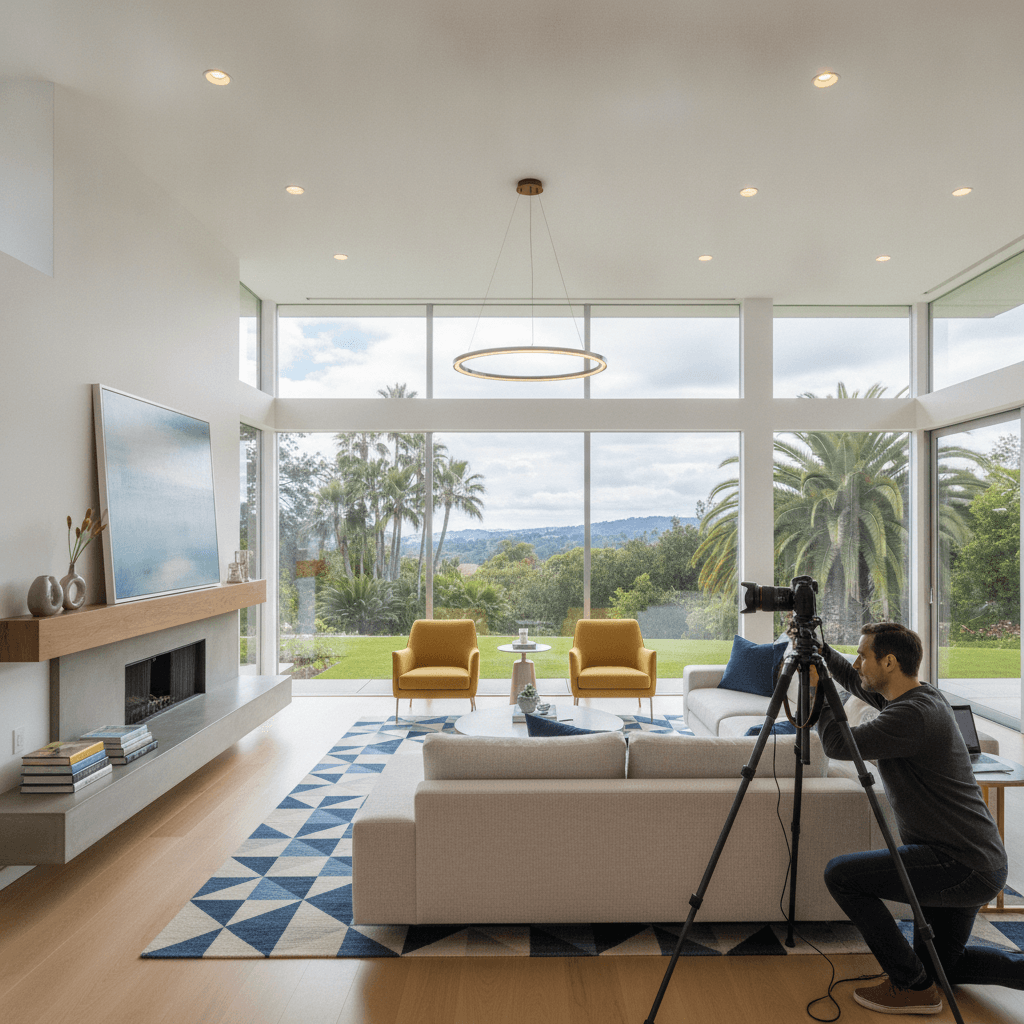
Photographers typically work through the property in a deliberate order so that the final gallery feels like a guided visit. Bracketed exposures can help retain both interior detail and bright window views. Tripods, carefully selected camera height, and corrected verticals support accurate proportions.
The photographer should capture establishing views as well as useful details. A wide room view explains space, while a closer frame may show cabinetry, flooring, fixtures, or a finish that is important to the listing. The gallery should avoid excessive duplicates that make the property feel repetitive.
4. Record video and aerials when appropriate
Video paths should be planned rather than improvised. A short opening exterior or entry sequence can establish the property, followed by a logical route through the main living areas, bedrooms, outdoor spaces, and any defining feature. Vertical versions may be created for social distribution, while a horizontal edit may suit a listing page or YouTube.
Aerial work requires its own planning. The operator should assess weather, nearby obstacles, people, traffic, privacy, and the intended visual purpose before capture. If conditions are unsuitable, a safe reschedule is preferable to forcing a weak or risky exterior sequence.
5. Edit and deliver
Post-production should establish consistent white balance, natural colour, controlled highlights, corrected lens distortion, and straight architectural lines. Deliverables should be labelled clearly and exported for their intended uses, such as MLS, a website gallery, print, or a vertical social post.
Ask in advance how revisions are handled, which formats are included, when delivery is expected, and whether the agent receives usage-ready files. These operational details can matter as much as camera quality when a listing has a firm launch schedule.
Which Real Estate Media Formats Should You Choose?
There is no universal package for every listing. The most useful selection is the one that explains the property’s strongest decision-making factors without adding production that will not be used.
| Format | Best use | Questions it helps answer |
|---|---|---|
| HDR still photography | Every listing as the visual foundation | What do the rooms, finishes, condition, and outdoor areas look like? |
| 2D floorplan | Condos, townhomes, multi-level or unusual layouts | How are the rooms connected, and where are the levels and access points? |
| Video tour | Distinctive homes, lifestyle properties, luxury listings, and strong architectural flow | How does the home feel when moving from one space to another? |
| Drone or aerial media | Acreage, views, privacy, large lots, and properties needing geographic context | What surrounds the property, and how does the site relate to its setting? |
| Vertical social clips | Reels, Shorts, TikTok, and agent-led discovery campaigns | What is the most compelling feature to understand in the first few seconds? |
When still photography is enough
A well-planned photo gallery may be sufficient for a straightforward condo, townhome, or property where the principal selling points are visible in still images. That does not mean the work should be minimal. Accurate coverage, a strong opening image, and a logical sequence still matter.
When to add a floorplan
Add a floorplan when buyers may struggle to understand the arrangement from images alone. Multi-level homes, homes with additions, basement suites, compact condos, and renovated properties often benefit because a plan provides orientation before the showing.
When video or drone earns its place
Video is worth considering when movement, atmosphere, or a visual narrative is central to the property. Drone is most useful when the land, view, privacy, access, or surrounding setting is a meaningful part of the decision. A provider should be able to explain the purpose of each format rather than treating every listing identically.
Best Practices for Better Listing Photography
Prepare for clean, realistic frames
Decluttering does not mean stripping a home of all personality. Keep a small number of intentional objects that communicate scale and use, but remove visual noise from counters, floors, bedside tables, and entry areas. The aim is to help viewers notice the room rather than the preparation process.
Use a consistent visual language
Mixed colour temperatures, leaning walls, extreme wide-angle distortion, and inconsistent camera heights can make a gallery feel careless. Straight verticals, believable colour, restrained contrast, and a repeatable room-to-room height create a more professional impression.
Sequence the gallery for understanding
Lead with a strong exterior or principal room, then guide the viewer through the property. Avoid placing a minor utility space before the kitchen or living room unless the property’s story genuinely requires it. End with supporting spaces, outdoor living, or a detail that reinforces the listing’s main appeal.
Match every export to its channel
MLS, websites, print materials, and social platforms have different display conditions. A web gallery needs clear, efficient files; a social post needs a strong crop and immediate visual hook; a printed feature sheet needs sufficient resolution and legible layout. Delivering one file type for every use can create unnecessary quality or cropping problems.
What to Look for in a Professional Provider
Equipment matters, but a reliable workflow matters more. A provider should be able to describe how they plan rooms, control exposure, preserve window detail, correct geometry, measure floorplans, and prepare deliverables. Ask to see complete galleries and finished videos, not only hero images.

A useful technical setup may include full-frame cameras, wide-angle lenses used responsibly, sturdy tripods, gimbals for smooth motion, calibrated monitors, and laser or LiDAR measurement tools. None of those tools guarantees a good result on its own. The final test is whether the delivered media is accurate, coherent, and ready for the channels where buyers will encounter it.
For guidance on combining stills, movement, and a listing narrative, the real estate video tour guide provides a useful framework for scene order, pacing, and voiceover decisions.
Questions to ask before booking
- Which deliverables are included, and which are optional?
- How long does delivery normally take after the shoot?
- Are floorplans measured or diagrammed from supplied information?
- How are weather, access, occupied rooms, and reshoots handled?
- Will the files be prepared for MLS, web, print, and vertical social use?
- Can you review complete examples from similar property types?
Choosing a Provider in Maple Ridge, BC
Choosing real estate photography services in Maple Ridge involves both creative and practical considerations. A local provider may understand the visual differences between suburban homes, townhomes, condos, acreage properties, and neighbourhoods with mature trees or changing seasonal light. That local familiarity can help with scheduling, exterior angles, and deciding when aerial context is genuinely useful.
Silver Valley Studios Inc. is based in Maple Ridge and serves communities including Abbotsford, Mission, Chilliwack, Langley, Surrey, Coquitlam, Burnaby, Richmond, and other parts of Greater Vancouver, as well as Vancouver Island. The business focuses on real estate media and brand content, including photos, video tours, 2D floorplans, vertical videos, and drone coverage.
Local planning considerations
Weather can change quickly in the Lower Mainland, so a shoot plan should distinguish between interior priorities and exterior windows. Overcast conditions can produce soft exterior light, while a brief clear period may be valuable for showing a view or yard. The right choice depends on the property and the visual claim the listing needs to support.
Maple Ridge properties may include larger lots, wooded edges, cul-de-sacs, newer subdivisions, and homes where access or privacy is part of the appeal. Exterior photography should show the relationship between the house, driveway, yard, and surrounding setting without overstating what the camera can reveal.
Agents who want a repeatable preparation and launch process can use the real estate photography guide to organize the week before a listing shoot and reduce last-minute decisions.
DIY Versus Professional Real Estate Media
DIY photography can be appropriate for internal documentation, early renovation records, or a property where the marketing requirements are limited. It becomes more difficult when the listing needs consistent exposure, accurate geometry, multiple output formats, a measured plan, video, or aerial context.
| Decision factor | DIY approach | Professional service |
|---|---|---|
| Consistency | Depends on equipment, room conditions, and operator experience | Uses a repeatable capture and editing workflow |
| Time | Preparation, capture, editing, and exports remain with the agent or seller | Production is handled as a defined service |
| Layout communication | Floorplans may be unavailable or require separate work | 2D floorplans can be planned with the rest of the media |
| Video and aerials | Requires additional skills, equipment, and planning | Can be integrated when the property benefits from them |
| Launch readiness | Files may need further resizing, editing, or naming | Deliverables can be prepared for planned channels |
The decision should be based on the listing’s needs and the value of the agent’s time, not on the assumption that every property requires the largest available package. A clear brief helps a professional provider scale the production to the property.
How Drone Media Supports a Listing
Drone imagery is most persuasive when it shows something a ground-level camera cannot. A rear oblique view may clarify yard depth and privacy, while a wider establishing frame may show a view corridor, nearby natural setting, or relationship to surrounding roads. The chosen angle should support a specific buyer question.

Weather and site conditions affect the result. Wind, rain, low visibility, trees, wires, nearby people, and restricted operating conditions can all change what is practical. Discuss the intended use before the shoot so the provider can decide whether aerial stills, video, or no drone coverage is the most sensible option.
For a property with a strong lifestyle story, the real estate videography services page can help agents compare motion-led coverage with a still-first listing package.
Why 2D Floorplans Help Buyers
A 2D floorplan gives a listing a spatial reference that photographs cannot provide by themselves. It can show approximate room relationships, levels, stairs, entries, and outdoor connections. For buyers comparing several properties, that information makes it easier to eliminate unsuitable layouts before arranging a visit.
Plans should be presented clearly and described accurately. If dimensions are approximate, the listing should not imply survey-level precision. Room labels should distinguish bedrooms, offices, flex spaces, storage, and other areas so a viewer does not have to infer their purpose from a photograph.
When video is also available, the two formats can reinforce each other. A viewer can watch the route through the home and refer back to the plan to understand where each scene occurs. The realtor videographer guide discusses ways to connect movement, room order, and visual storytelling.
How to Distribute Real Estate Media
Launch the core listing assets first: the main photo gallery, property information, and floorplan where applicable. Then adapt the strongest visual moments for discovery channels. A vertical clip can focus on the kitchen, view, entrance, or outdoor area, while a longer horizontal tour can provide a fuller experience on a listing page.
Build each post around one idea
A social clip is easier to understand when its opening and caption focus on one feature. Examples include a bright open kitchen, a private backyard, a view from the main living room, or a floorplan that explains a multi-level layout. Avoid trying to communicate every room in a short clip.
Use crops and thumbnails deliberately
Vertical formats may crop wide rooms or remove important context. Choose the crop before publishing and make sure the opening frame still identifies the property visually. A bright, well-composed thumbnail generally communicates more effectively than a dark frame from the middle of a transition.
Reuse the production intelligently
One shoot can support several assets without requiring several unrelated shoots. A principal room may become the lead still, the opening video frame, a vertical clip, and a thumbnail. Reuse works best when each version is edited for its channel rather than copied without adjustment.
Agents who also need consistent professional portraits and marketing imagery can review the realtor branding photography service to align personal brand visuals with listing campaigns.
Common Mistakes to Avoid
The most damaging mistakes are usually avoidable production or communication problems. A gallery can lose credibility through inconsistent colour, crooked lines, blown-out windows, misleading crops, or an order that makes the property difficult to follow.
- Over-editing: Excessive saturation, artificial skies, or heavy retouching can create expectations the property does not meet.
- Missing context: Tight images may make rooms look attractive but leave viewers unsure about scale or connection.
- Weak preparation: Clutter, open toilet lids, visible bins, and parked vehicles can distract from the home.
- Format mismatch: A horizontal video or uncropped still may not work well in a vertical social placement.
- Unclear delivery: Late files, confusing names, or missing exports can delay a planned launch.
Reviewing the complete delivery checklist before booking helps prevent most of these issues. It also gives the agent an opportunity to explain which features require special attention.
Frequently Asked Questions
What is included in real estate photography services?
Services may include professional HDR or exposure-blended still photography, cinematic video tours, 2D floorplans, vertical social clips, and drone coverage. The exact combination should be selected according to the property and distribution plan. Confirm the included deliverables, formats, usage, and delivery timing before booking.
How many photos should a property listing have?
There is no universal number that suits every property. The gallery should cover the exterior, principal rooms, bedrooms, bathrooms, secondary spaces, storage where relevant, and outdoor areas without repeating nearly identical frames. The right count is enough to explain the property clearly while keeping the viewer focused.
Does every listing need a floorplan or drone photos?
No. A floorplan is most valuable when the layout is difficult to understand from photos, while drone media is most useful for views, acreage, privacy, large lots, or surrounding context. A provider should recommend each format based on a real communication need rather than automatically adding it.
How should I prepare a home for a photo shoot?
Declutter counters and floors, make beds, hide personal documents and loose cables, organize entry areas, and move vehicles where possible. Adjust blinds consistently and decide where pets and residents will be during capture. Also tell the photographer about renovations, restricted rooms, important views, and any access limitations.
Key Takeaways
Real estate photography services are most effective when they are planned as one clear listing system rather than a collection of disconnected files. Start with accurate, well-sequenced still photography, then add a floorplan, video, vertical clips, or drone coverage when those formats answer questions the photos cannot.
- Use photos to establish condition, finish, scale, and atmosphere.
- Use floorplans to explain room relationships, levels, and access.
- Use video to communicate movement, flow, and lifestyle.
- Use aerials to show lot, privacy, views, and geographic context.
- Choose a provider based on complete work, workflow, accuracy, and delivery - not equipment claims alone.
- For Maple Ridge and Greater Vancouver listings, plan around property type, seasonal light, weather, and exterior context.
Plan Your Next Listing Shoot
The strongest real estate media gives buyers a clear and honest understanding of a property before they arrive. A consistent workflow, thoughtful preparation, accurate editing, and channel-ready delivery help agents present listings with confidence across MLS, websites, and social platforms.
For a Maple Ridge or regional listing, begin by identifying the property’s main decision-making features and the media needed to explain them. Then contact Silver Valley Studios Inc. to plan a practical package of photography, video, floorplans, vertical content, or drone coverage.