

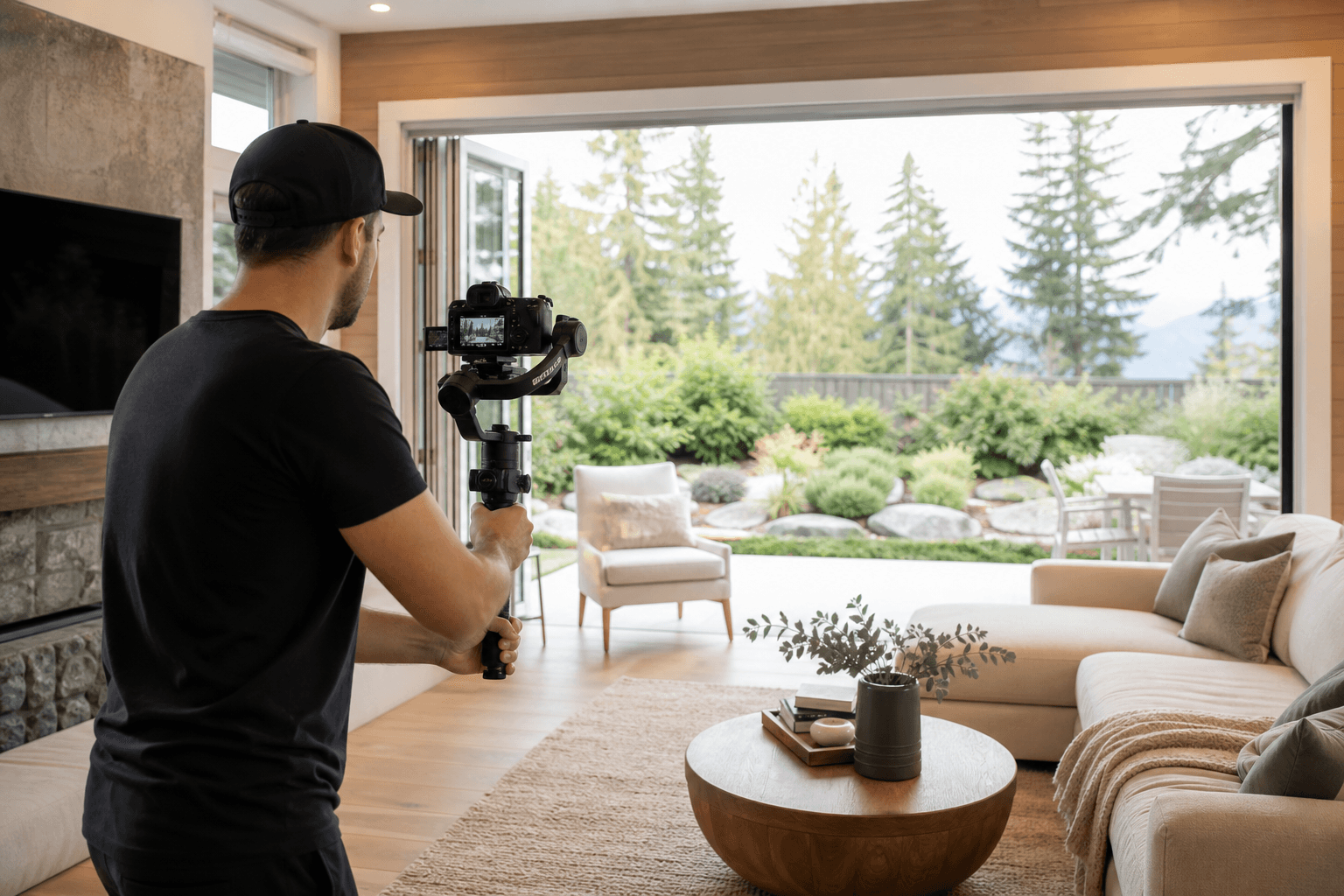
The right listing video is not automatically the longest, most cinematic, or most heavily produced option. It should match the property's strongest story, intended audience, publishing channel, and the other deliverables needed for launch.
This real estate videography checklist is designed for realtors, real estate teams, listing managers, developers, and sellers. Use it to choose a format, prepare the property, brief the videographer, confirm production constraints, compare proposals, and organise delivery before shoot day.
Quick summary

- Choose a primary video format based on the property's layout, audience, and publishing destination.
- Prepare the home, access arrangements, exterior areas, and seller expectations before filming.
- Plan a viewing path that explains the property accurately instead of collecting disconnected attractive shots.
- Confirm drone feasibility, weather contingencies, delivery timing, file requirements, and approval responsibilities.
- Compare providers by scope and communication, not price alone.
1. Choose the video format that matches the listing's purpose
Start by deciding what the video must help viewers understand or do. A property video tour can explain layout and flow, while cinematic 4K video can create a more polished sense of atmosphere. Vertical video is useful for social-first viewing, and drone videography can show the property's exterior setting when appropriate.
Not every listing needs every format. A compact home may benefit most from a clear tour and short social edit, while a large property, development, or home with notable outdoor context may justify a broader combination of footage. Silver Valley Studios describes these formats as serving different storytelling roles, rather than treating one production style as suitable for every property.
| Format | Best use | What it should communicate | Limitation |
|---|---|---|---|
| Property video tour | Explaining the home to prospective buyers | Room relationships, flow, features, and scale | Clarity matters more than dramatic movement |
| Cinematic 4K video | Polished presentation for a suitable listing or project | Atmosphere, progression, composition, and detail | It may be unnecessary when a simple tour meets the objective |
| Vertical video | Short-form social content | One strong feature, moment, or visual idea | It cannot explain the entire layout in a short frame |
| Drone videography | Exterior, site, and surrounding context | The relationship between the property and its setting | Feasibility and usefulness vary by location and objective |
Before requesting a quote, write one sentence describing the video's job. For example: “Show how the home connects its main living areas to the garden for buyers viewing the listing online.” That sentence gives the provider a better starting point than simply asking for a cinematic video.
For a broader comparison of formats and how they support a listing story, review this explanation of real estate video storytelling.
2. Prepare the property, access, and exterior areas

Good preparation protects the filming window and keeps attention on the property instead of avoidable distractions. The agent, seller, or listing manager should confirm who is responsible for each task before the crew arrives.
- Remove excess items from counters, floors, shelves, and entryways.
- Complete any agreed staging, including furniture placement and decorative adjustments.
- Open blinds or curtains where appropriate, replace burnt-out bulbs, and turn on relevant lights.
- Tidy patios, balconies, gardens, driveways, garages, and other exterior areas that may appear in the footage.
- Arrange access, keys, parking, alarm instructions, pets, tenants, and any rooms that must remain private.
- Tell the videographer about renovations, unfinished areas, access limitations, or features that need careful representation.
Ask the seller to leave enough time for a final walk-through rather than treating preparation as a last-minute task. A prepared home gives the videographer more freedom to concentrate on composition, movement, and accurate coverage.
Weather and daylight should also be part of the plan, particularly when exterior footage is important. For local planning considerations, including property preparation and weather contingencies, see this real estate videography preparation checklist.
3. Plan an accurate shot sequence and viewing path
A shot list should help viewers understand where they are in the property. Begin with an establishing frame or feature that gives context, then move through the home in a logical order. Avoid jumping randomly between rooms simply because each individual clip looks attractive.
A useful sequence might introduce the exterior, enter through the main access point, establish the main living area, connect adjoining spaces, show bedrooms and practical areas, and finish with the feature that best supports the property's central idea. The exact order depends on the layout, but the viewer should not have to reconstruct the floor plan from disconnected footage.
Include a balance of wide views, transitions, and purposeful details. A wide shot can establish a room, a moving shot can explain its relationship to another space, and a close detail can reinforce a feature such as cabinetry, a fireplace, or an outdoor connection. Every shot should earn its place by adding context, atmosphere, or useful information.
Check factual accuracy before filming and again during review. The video should not imply a room is larger, a view is closer, or two spaces connect differently than they do in reality. This is where choosing real estate videography shots becomes a planning decision rather than a purely creative one.
4. Write a production brief before filming
A short written brief reduces guesswork and gives everyone a reference point when choices arise on site. It also makes proposals easier to compare because each provider receives the same essential information.
Include these details:
- Property: address, property type, approximate size, key features, and access restrictions.
- Objective: the one primary job the video must perform.
- Audience: likely buyers, investors, tenants, developers, or social viewers.
- Format: property tour, cinematic 4K video, vertical video, drone footage, or a defined combination.
- Priority areas: rooms, views, amenities, outdoor spaces, or construction details requiring emphasis.
- Accuracy notes: facts, dimensions, relationships, or exclusions that must be represented correctly.
- Approval owner: the person who will review the draft and provide consolidated feedback.
- Destination: MLS, a listing page, YouTube, Instagram, TikTok, a development website, or another channel.
- Deadline: the date finished files are needed, not merely the shoot date.
Keep the brief focused. A video with five competing objectives is harder to shoot, edit, review, and publish than one with a clear priority. If you are commissioning a higher-production video, these cinematic 4K property video checks can help clarify the purpose, approvals, and publishing destination before filming.
5. Confirm drone, weather, and location feasibility
Drone footage should be treated as a confirmed production element, not an automatic add-on. Before booking, provide the exact address and explain what you want the aerial footage to show. The provider can then assess whether the requested shots are practical and whether an alternative approach is needed.
Ask who will confirm permissions, location constraints, timing, and other requirements relevant to the planned flight. Do not assume that a nearby view, particular altitude, or specific flight path will be available. If aerial footage is not feasible, alternatives may include elevated exterior angles, ground-level approaches, detail footage, or a stronger interior sequence.
Weather planning matters even when the main shoot is indoors. Rain, wind, changing light, wet surfaces, and poor visibility can affect exterior footage and the overall appearance of the property. Agree on a backup plan, rescheduling responsibility, and whether interior footage can proceed separately.
For a property in Maple Ridge or elsewhere in British Columbia, give the provider enough notice to assess the address and preferred exterior window. The goal is to confirm what can be captured and decide what will replace it if conditions change.
6. Compare providers by scope, communication, and revisions
When comparing proposals, put each provider's offer into the same checklist. A low headline price may not represent the same number of deliverables, formats, planning support, turnaround, or revision expectations.
- What exact video formats and lengths are included?
- Are vertical edits, drone footage, music, captions, or agent appearances included or separate?
- Who creates the shot plan, and how are property priorities communicated?
- What is the expected turnaround for each deliverable?
- How does the review and revision process work, and who consolidates feedback?
- Which file types, aspect ratios, resolutions, and publishing-ready versions will be delivered?
- Can photography, video, aerial coverage, and floorplans be coordinated in one visit?
- What happens if weather, access, or drone feasibility changes the agreed plan?
- How are booking, quote approval, payment, and project updates handled?
Silver Valley Studios states that its workflow can capture photos, vertical and cinematic videos, aerials, and floorplans in one visit. Its website also states same-day HDR photo delivery, next-day 2D floorplans, and video delivery within 48 hours. Treat those as the studio's stated planning information, then confirm the applicable scope and timing for your property.
Communication is part of the deliverable. A provider that understands the brief, identifies constraints early, and gives one clear place for approvals may be easier to manage than a provider whose proposal lists attractive outputs but leaves responsibilities unclear.
If you are coordinating a listing around a move or handover, share the property address, access window, desired formats, and deadline when requesting a quote. This information to include for a video quote can help keep the initial request specific and useful.
7. Coordinate video delivery with photos and floorplans
Video is only one part of a listing launch. Before booking, confirm how it will work alongside still photography, drone images, and 2D floorplans so that each deliverable supports the same presentation without duplicating its role.
Ask for the delivery requirements of every destination. A listing page may need a horizontal property tour, while social channels may need a vertical edit. Confirm aspect ratios, resolution, file naming, captions, music preferences, thumbnail expectations, and whether the agent or provider is responsible for uploading the finished files.
Set an approval sequence before the shoot. Decide who checks factual accuracy, who approves music or branding, and who gives final sign-off. Consolidated feedback from one responsible person is usually clearer than separate, conflicting comments from several stakeholders.
Also work backwards from the launch date. Allow time for filming, editing, review, revisions if included, file transfer, and publication. A coordinated media plan can combine real estate photography, property video tours, drone coverage, and 2D floorplans, but each item should still have a defined purpose. You can review the available real estate media services when mapping deliverables to the listing's needs.
Final booking checklist
- Property address, access instructions, parking, keys, pets, tenants, and rooms to be filmed.
- Primary video objective, intended audience, publishing destinations, and selected formats.
- Priority rooms, features, exterior areas, and the planned viewing path.
- Seller preparation, staging responsibilities, lighting expectations, and exterior readiness.
- Drone feasibility, permissions or confirmations, weather plan, and alternative footage.
- Photography, video, aerial, and floorplan deliverables, including file formats and aspect ratios.
- Turnaround, review process, revision expectations, approval contact, and final launch deadline.
- Quote scope, add-ons, booking terms, and the person responsible for each next step.
Frequently asked questions
Does every listing need a cinematic real estate video?
No. Choose cinematic production when atmosphere, design, progression, or a distinctive property story is central to the marketing objective. A straightforward property tour may be more useful when the priority is explaining layout and room relationships clearly.
When should a realtor choose vertical video instead of a full property tour?
Choose vertical video when the primary destination is a short-form social channel and the goal is to highlight one feature, moment, or visual idea. Use a full tour when viewers need a more complete understanding of the home's flow.
What should I do if drone footage is not feasible?
Ask the provider to explain the constraint and suggest replacement shots, such as a carefully planned exterior approach, elevated ground-level footage, or additional interior details.
How early should I book real estate videography before a listing launch?
Book as soon as the launch window, property access, and deliverables are reasonably known. Early planning gives you more opportunity to coordinate preparation, preferred light, drone feasibility, editing, approvals, and publication.
Conclusion: book the deliverables that clarify the property
A useful real estate videography checklist starts with the listing's purpose, not the equipment or the most impressive-looking format. Choose the video type that serves the audience, prepare the property and access, plan an accurate viewing path, document the brief, confirm aerial and weather constraints, compare proposals carefully, and coordinate delivery with photos and floorplans.
When you are ready to plan a coordinated shoot, Silver Valley Studios Inc. provides real estate photography, videography, aerial coverage, and floorplans from its Maple Ridge base for clients across the Fraser Valley, Metro Vancouver, and the supplied regional service area. Request a quote with the property address, desired deliverables, access details, and launch deadline so the scope can be confirmed before filming.