


A practical visual content planning guide for realtors
Short answer. Start with the questions buyers and sellers need answered, not a list of formats. Map those questions to the listing lifecycle and your evergreen expertise. For each visual, define the source facts, approval owner, master asset, channel adaptations, usage rights, call to action and measurement. One well-planned shoot can support several accurate pieces, but no photo or video format can guarantee reach, leads, showings or a sale.
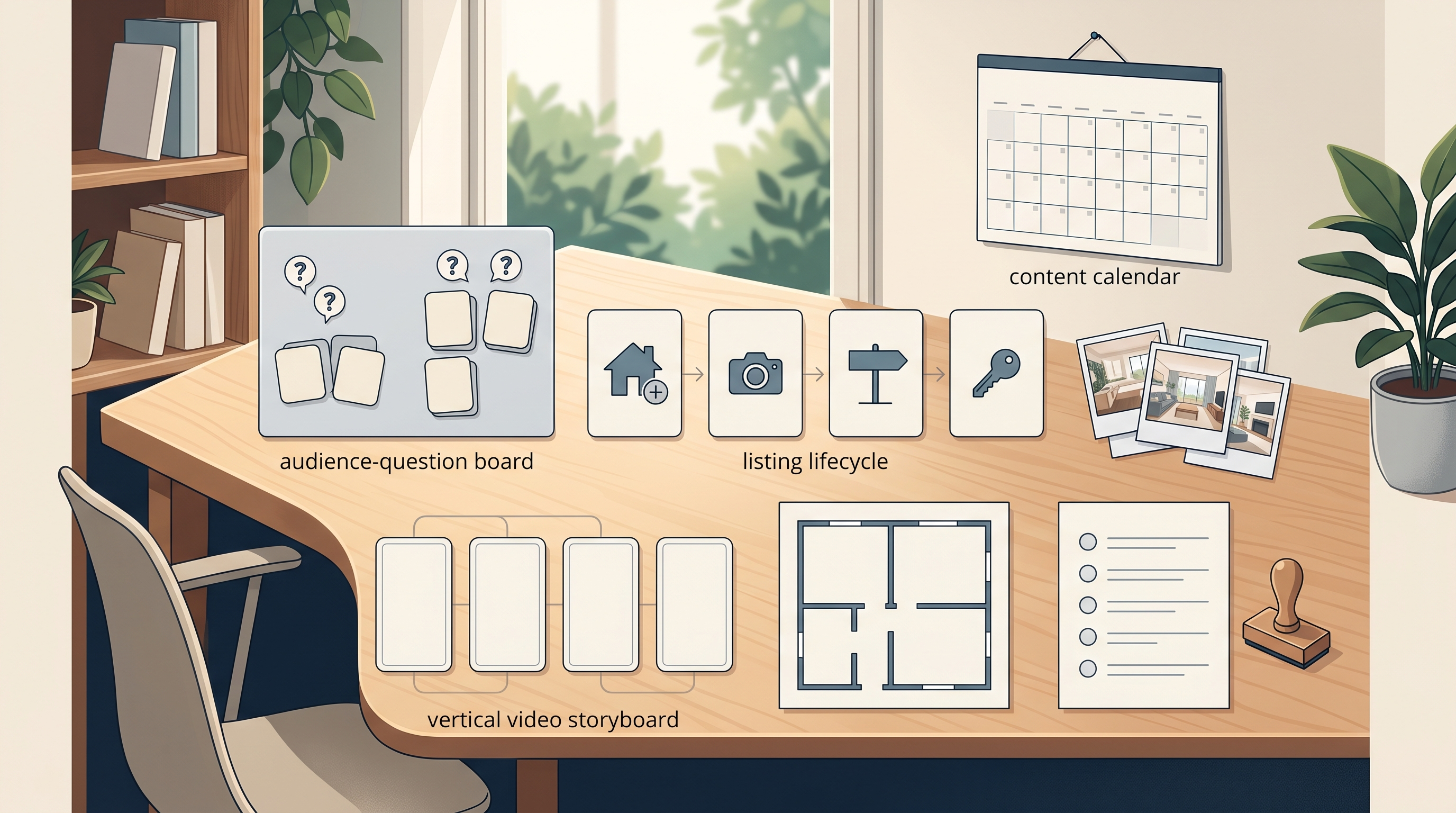
A useful visual strategy starts with audience questions and decisions, then assigns the right asset, approval, channel and next action.
Table of contents- Start with audience decisions
- Choose content pillars
- Build an asset matrix
- Create an accuracy workflow
- Plan the capture day
- Adapt assets by channel
- Clarify rights and privacy
- Measure useful signals
- Avoid common strategy mistakes
- Frequently asked questions
- Create a one-page brief
Start with the decision your audience is making
A visual earns a place when it helps someone understand a property, neighbourhood, process or professional point of view. List recurring questions from sellers, buyers and past clients. Group them by decision: whether to prepare a home, how a listing process works, what a property layout means, which facts need professional verification or what happens after an inquiry.
Do not turn a property campaign into generic lifestyle content. A buyer examining a listing needs accurate space, sequence and condition context. A seller considering services needs to understand process and deliverables. A past client may value concise maintenance or market-literacy explainers, with appropriate sources and caveats.
Silver Valley Studios currently publishes real estate media and social media content services. Its public site can support a scope conversation, but exact deliverables, turnaround, rights, service area, pricing and availability need current confirmation.
Choose three content pillars with different jobs
Property understanding
Use accurate photography, video sequence and floorplan context to help viewers orient themselves. A visual does not verify measurements, legal use, permits or condition. Source every factual claim separately.
Seller and buyer education
Build short explanations around questions such as preparation, showing access, offer terminology or closing coordination. Keep regulated, legal, financial and property-specific advice with qualified professionals.
Professional perspective
Show how you prepare, communicate and make decisions without inventing client stories or outcomes. A process example can demonstrate clarity even when transaction details remain private.
Give each pillar a fixed purpose and next action. Property content may lead to listing details; education may lead to a related guide; professional perspective may lead to a consultation. Do not force every piece to ask for an appointment.
Build one visual content matrix for the quarter

Tie every asset to one audience question, verified source, approval owner, channel adaptation and useful next action.
| Stage | Audience question | Useful master asset | Possible adaptation |
|---|---|---|---|
| Evergreen education | How does this step work? | Horizontal explainer | Short clips, stills and checklist |
| Pre-listing | What should be prepared? | Process storyboard | Carousel and email section |
| Listing launch | How does the space connect? | Photo set, video and floorplan where scoped | Portal selects and vertical preview |
| Showing support | Which verified details matter? | Fact-led visual sequence | FAQ card and property-page section |
| After campaign | What can we learn? | Internal content review | Future brief improvements, not unsupported result claims |
Plan around master assets rather than producing isolated posts. A horizontal interview can yield short vertical excerpts and still frames when the framing, audio, captions and rights are planned in advance. A property shoot can support several placements when every crop remains accurate.
Create a source and approval workflow
Every property statement should have a source owner. Separate visual observation from verified listing fact. A room may appear renovated, but the date, permit status and work scope require records. A floorplan aids orientation but does not replace a survey, appraisal or legal description.
Use four approvals: property facts, visual accuracy, privacy and final channel version. The BCFSA consumer guide to real estate advertising says advertising should be current and accurate and warns against misleading photo alteration in its jurisdiction. Confirm the rules governing the actual professional, property and platform.
Define permitted edits. Exposure, colour balance and perspective correction may support a faithful image; removing damage, adding fixtures or changing a view can mislead. Label virtual staging clearly and preserve an accurate reference where required.
Plan capture around the complete asset system
Create a shot list tied to the matrix. Record orientation, room sequence, exterior context, detail, presenter segments, ambient sound and alternate crops. Decide which master shots need clean space for captions and which require both horizontal and vertical framing. Confirm weather, access, occupants, pets, sensitive items and owner authorization.
For every talking segment, write one audience question, three supporting points and one next action. Avoid memorized promotional monologues. Capture enough context that an excerpt remains accurate when separated from the longer piece.
Review Silver Valley Studios' current portfolio to discuss visual fit, not to assume that another property's scope, conditions or results will be the same.
Adapt each asset instead of blindly reposting it
A channel adaptation needs more than resizing. Reframe the opening for what a viewer can understand without prior context. Add captions, descriptive text and a clear destination. Keep factual qualifiers visible. Check current platform specifications at publication time because formats and interfaces change.
Maintain a content ledger with the master file, approved facts, owner authorization, music or stock licences, versions, publication locations and expiry or removal conditions. If a listing changes status or a fact changes, the ledger helps find every version that needs review.
Create a sustainable cadence from approved assets. A useful sequence might move from audience question, to concise answer, to property or process example, to deeper guide. Volume without a decision purpose creates noise and increases approval risk.
Clarify usage rights, privacy and drone planning
Confirm who owns the files, who may publish them, on which channels, for how long, whether paid advertising or third-party reuse is included and who can edit them. Obtain owner and occupant permissions appropriate to the capture and use. Remove visible personal data, security details, family photos, licence plates and private documents where needed.
Drone work needs flight-specific review. Transport Canada explains that rules depend on what is flown, how, where, when and by whom. Its privacy guidance notes that privacy obligations can apply to images and other information collected by drones. Never assume a property location or aircraft is approved based on an earlier flight.
Measure content usefulness without promising outcomes
Choose measures that match the asset's job. For education, track qualified questions, guide visits or completion. For a listing, review how viewers use the property page, while avoiding claims that a format caused showings or sale results. For process content, track whether prospects arrive better prepared.
Record the baseline, period, channel, call to action and limitations. Engagement is not automatically a lead; a lead is not automatically a client; a viewing is not automatically a transaction. Use findings to improve the next brief rather than manufacture a success claim.
- Review which audience questions were answered.
- Identify assets that needed factual correction.
- Note which master files adapted cleanly.
- Compare useful actions with the stated purpose.
- Update the next quarter's matrix and retire stale content.
Common visual content strategy mistakes
Starting with a format trend
Begin with an audience decision, then choose the format.
Using one crop everywhere
Plan channel-specific framing, captions and context from the master asset.
Letting visuals imply unverified facts
Keep a source and approval record for property statements.
Ignoring rights and expiry
Document ownership, allowed uses, music, stock, talent and removal conditions.
Calling engagement a business result
Measure the action the asset was designed to support and state limitations.
Frequently asked questions
How often should a realtor publish visual content?
Use a cadence your fact-checking and approval process can sustain. Consistency does not require daily posting.
Should every listing include video and drone media?
No. Choose assets based on the property, audience question, budget, access, rights and legal feasibility. Confirm the actual scope.
Can one shoot create a month of content?
Potentially, if the brief includes reusable master assets, multiple orientations, accurate context and usage rights. No fixed output should be assumed.
Which metric matters most?
The metric tied to the asset's intended action, interpreted with its limitations. There is no universal measure.
Create a one-page visual content brief
List the audience question, decision stage, verified facts, master asset, adaptations, approvals, rights, call to action and measurement. Review Silver Valley Studios' current educational content, then use its contact route to request a project-specific scope. Confirm every deliverable and right before capture.